
Why Hiring a Virtual Assistant Didn’t Solve the Problem
At some point, most business owners realize they need help.
It's a fresh start to the week. Your coffee is hot, the weather is beautiful, and you sit down to check your emails...
- The inbox is growing
- Customer requests keep coming in
- Invoices need attention
- Vendors need answers
- Processes live in notebooks, sticky notes, and memory
There simply aren't enough hours in the day to manage all of this while also focusing on the work that made you start the business in the first place. So, they hire a Virtual Assistant (VA) to take on some of the administrative workload off their plate.
- Tasks get completed
- Emails get answered
- Calendars get managed
- Administrative work starts moving off the owner's plate
But sometimes something unexpected happens - where, despite having help, the business still feels chaotic as it ever did. Even though all of those tasks and back / front end requirements are being completed.
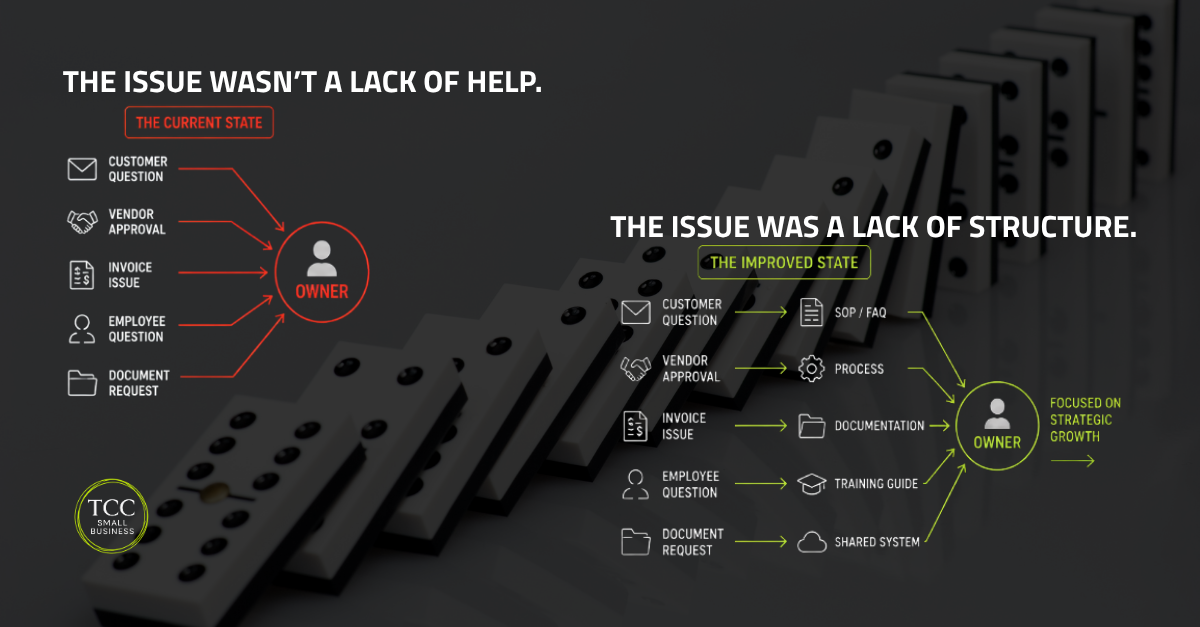
All the same questions that were coming in from emails still come back to the owner because the clarification isn’t there. The same bottlenecks still exist. Tasks become delayed because information is difficult to find, inconsistent, or only exists in the owner's head. The workload may have been delegated. However, the underlying problems remain the same. The issue wasn't a lack of help.
The issue was a lack of structure, processes and organization. This is one of the most common challenges affecting small business operations, especially as companies begin to grow.
The Difference Between Tasks and Operations
A Virtual Assistant is often hired to help complete tasks.
Examples might include:
- Managing emails
- Scheduling appointments
- Data entry
- Calendar management
- Administrative support
These services can be extremely valuable. However, completing tasks and improving operations are two different things. If a process is disorganized or doesn’t exist, assigning someone new to perform these processes doesn’t automatically make it efficient. It simply means someone else is now navigating the same challenges that you already encounter.
When More Help Creates More Questions
Many small business owners find themselves becoming the central hub for every decision - rightfully so, it’s their business. However, if they have employees, those employees need to know where documents are stored, how customer inquiries should be handled, and what the status is on vendor invoices and approvals. Even the bookkeeper needs information to complete month-end reporting.
But for a small business owner who hires a Virtual Assistant, many of the same challenges still remain. They too will have questions about a task they've never handled before.
- “Who approves this?”
- “Where is the supporting documentation located again?”
- “Wait - wasn’t this already paid?”
- “What account is this assigned to?”
- “Ok - now what?”
Individually, none of these requests seem particularly significant. However, when they occur throughout the day, they create a constant stream of interruptions that pull the owner away from the work they should be focused on. Every question may only take a minute or two to answer, but when those questions arrive dozens of times a day, the impact becomes impossible to ignore.
The challenge is rarely the people involved. More often than not, the issue is that the information, processes, and expectations have never been properly documented. Instead, they exist across emails, notebooks, spreadsheets, sticky notes, and the owner's memory.
When this is the starting point, adding another team member often creates another person who depends on the owner for direction. The business becomes busier without becoming more efficient because the underlying issue still exists.
This is often the point where operational solutions become necessary. Not because the business needs more people, but because it needs better business systems, clearer processes, and a structure that allows information to be accessed without everything flowing through a single person.
What Are Operational Solutions?
Operational solutions focus on improving how the business functions behind the scenes. Rather than simply completing tasks, the goal is to create structure, consistency, and clarity for the long term.
This can include:
- Process development
- SOP (Standard Operating Procedures) creation and documentation
- Workflow improvements
- Vendor coordination
- Financial administration processes
- Organizational systems
- Team procedures and accountability
Whether it's an employee, a bookkeeper, a Virtual Assistant, or a contractor helping behind the scenes, the same challenge remains when critical information only exists in one person's head.
A Simple Shift in Perspective
One of the biggest misconceptions in business is that every problem requires more people. In reality, many problems are caused by unclear processes, inconsistent systems, or a lack of documentation. Adding people to a broken workflow rarely fixes the underlying issue.
Improving how work is completed often reduces the need for constant oversight...
Whether it's an employee, a bookkeeper, a Virtual Assistant, or a contractor helping behind the scenes, the same challenge remains when information only exists in one person's head.
The VA Isn't the Problem
It's important to recognize that Virtual Assistants provide valuable services and play an important role in many businesses.
In fact, there are plenty of situations where hiring a Virtual Assistant is exactly the right decision. If the tasks are clearly defined, processes already exist, and the primary challenge is capacity, a Virtual Assistant can be an excellent addition to the team.
The challenge occurs when business owners expect a task-based role to solve an operational problem. They shouldn't be expected to create the entire operational structure of a business from scratch.
These are two different needs requiring two different solutions.
The question isn't whether a Virtual Assistant is the right choice. The question is whether the business needs more help doing the work, or whether it needs better systems for how the work gets done.
The Goal Is Independence
At the end of the (business) day - the purpose of operational solutions isn't to create more work, more complexity, or more dependency. It's to bridge the gap between how a business operates today and how it needs to operate as it continues to grow.
The goal is to create a business that runs smoothly, regardless if the owner is present or not. A business where all the information is documented and the processes are repeatable. Expectations are clear and the daily operations are no longer held together by memory alone.
Because sometimes the solution isn't finding more help.
Sometimes the solution is building a better way of working.